Design a School Bag for Young Children
A primary-school child carries books, a water bottle, lunch, and stationery to school every day. The bag should be comfortable to carry, easy for the child to organise, and prevent items from getting damaged or lost. Design a school bag for children aged 6–10 with compartments and features suited to their daily needs. Consider weight distribution, easy access, safety, and visibility. Aesthetic direction: The bag should feel playful, friendly, and energetic, using rounded forms, soft edges, and simple visual elements that appeal to children without becoming overly decorative. Sketch your design and visually explain the features with clear labels.
Notes
- Make pencil sketches only.
- Show rough iterations
- Use labels mandatorily.
- Sketch out final sketch with proper details.
Start timer
Evaluation criteria
- Appropriateness of three-dimensional form and visual graphics
- Provisions for fulfilling functional requirements
- Considerations for product usability by the user
- Attention to detail and explanation of features through visuals only
- Clarity of the sketch and quality of presentation, and uniqueness of design.
Submit your sketch
Upload your work to appear in the gallery after review.
Community Work
Loading sketches…
Community Work
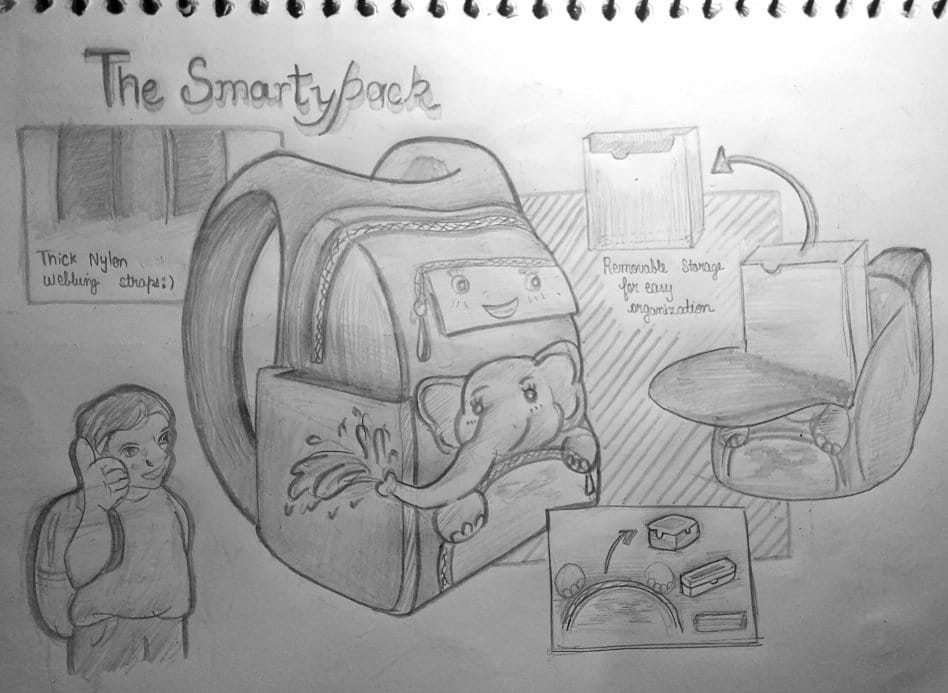
Parul
You’re progressing well the idea and layout are coming together. Now it’s mostly about refinement. The biggest thing is don’t over shade. Too much shading can make the sketch look heavy and muddy. Use different pencil grades lighter pencils for construction and broad tones, darker pencils only for details and key highlights/shadows. You can also create depth through line density and stroke direction instead of shading everything equally. For the page layout, keep it simple and organised. Let the 3D product sketch be the hero, use typography as a supporting element, and add small feature callouts or highlights around it. Give each element enough breathing space instead of filling every corner.
4.0 (1 ratings)